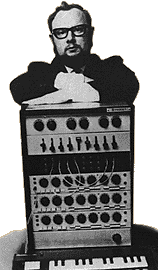
Picture: Paul Ketoff, the innovator of the portable Synket.
Text: Paul Jensen
The birth of the transistor in the late 1950s heralded a major turning-point in the development of facilities for electronic music. Hitherto the evolution of devices had been governed by the characteristics of thermionic valves. Problems of heat dissipation, fragility, and the sheer size of these components thwarted efforts to design systems which were both versatile and compact. The new technology suffered from none of these disadvantages and generated remarkably few of its own.
One of the first engineers to grasp the significance of this technological revolution for electronic sound synthesis was Harald Bode, the inventor of the Melochord. In 1961 he published an article on transistor-based devices, drawing particular attention to the advantages of modular design. Such a concept was new indeed, for with the advent of miniaturization it had become possible to envisage the production of easily transportable system packages, containing customized selections of self-contained and mutually compatible units such as oscillators, filters, and modulators.
The new designs were to prove revolutionary in another respect. Hitherto the functional characteristics of most studio devices had been controlled by uniquely assigned knobs or sliders. Connections between these units were thus concerned solely with the passing of audio signals from one stage in the synthesis chain to another. The versatility of transistor-based electronics made it possible to design any number of devices which could be controlled by a common set of voltage characteristics. These could be supplied either internally via manually operated regulators, or externally, from any suitable voltage source. The former mode of operation differed little from that employed for traditional studio equipment. The latter, however, introduced an entirely new dimension: the passing of control information from device to device via a secondary chain of interconnections.
Despite Bode's interest, the primary initiative passed elsewhere. In 1964 Robert Moog, an American engineer working in New York, constructed a transistor voltage-controlled oscillator and amplifier for the composer Herbert Deutsch. This led to the presentation of a paper entitled 'Voltage-Controlled Electronic Music Modules' at the sixteenth annual convention of the Audio Engineering Society in the autumn of the same year, which stimulated widespread interest.
Similar developments were taking place on the West Coast. Sender and Subotnick had become increasingly dissatisfied with the limitations of traditional equipment at the San Francisco Tape Music Center, and their quest for new devices led to an association with another engineer, Donald Buchla. Buchla, like Moog, appreciated the musical possibilities of transistor voltage-control technology, and proceeded to develop his own prototype modules. On the strength of their early successes both engineers, quite independently, decided to establish their own manufacturing companies, launching the first commercial versions of the Moog Synthesizer and the Buchla Electronic Music System almost simultaneously in 1966.
During 1964-5 a third engineer, Paul Ketoff, designed and built a portable voltage-controlled synthesizer, known as the Synket, for the composer John Eaton. Although interest in its capabilities, especially as a live performance instrument, led to the construction of a number of copies, the synthesizer was not marketed commercially. By the end of the decade other manufacturers were entering the market. Two became major rivals for Moog'and Buchla: Tonus, marketing under the trade name ARP in America, and EMS Ltd., pioneered by Peter Zinovieff in England. For several years synthesizer production was dominated by these four firms, each struggling for a major share of a highly lucrative and rapidly expanding market.
The growing accessibility of system packages was to prove a mixed blessing, for in many instances the ease of device interaction led to a fascination with the technology for its own sake, rather than the musical premises for its use. Manufacturers were naturally keen to publicize the more novel features of their wares, leaving unsuspecting composers to discover for themselves the practicalities of utilizing such equipment. Several of the smaller models offered only the most basic facilities, dissuading a number of potential electronic composers from investigating the possible merits of the medium any further.
In order to evaluate the musical characteristics of voltagecontrolled systems it is advantageous to understand the general principles upon which they operate. Except in the rarest of circumstances every studio device offers one or more adjustable characteristics. Oscillators, for example, are usually controllable in terms of both frequency and amplitude. Even a ring modulator, which is essentially of a fixed design, usually incorporates an amplifier to regulate the level of signals appearing at its output.
Itīs interesting imagine a world without the above mentioned constructors. When I meet Bob Moog during the eighties he gave me the impression of beeing at the right location att the right time. Itīs not new to me that every period of time supplies a weaving of ideas to get stuck into. I will not discredit Moog and other electronic circuit designers, but by way of conclusion Iīd like to say that no one can escape the shaping power of social arrangements and social institutions.